
The unknown future.
Joan’s possible happiness.
Don, Betty — oozing.
The unknown future.
Joan’s possible happiness.
Don, Betty — oozing.
A hand on Megan.
Stan and Pima, in the dark.
Don, like an island.
‘Stached Roger and Ted.
Peggy and Joan, hosed by men.
Don dreams of Rachel.
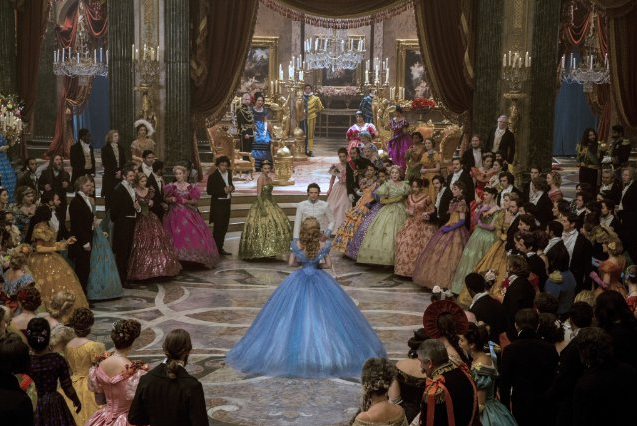
Courage and kindness
brings a girl in a blue gown
to eternal bliss.
On our drive over to the cinema yesterday afternoon, my wife and I tried to recall which movie we last saw on the big screen. We did catch the Oscar Shorts with friends a few months back, but for regular movies, the film that came to mind was Gravity. Which was two years ago! We actually saw at least two movies that year, as we also caught The Great Gatsby, in 3D no less.
So the movies that get us out of the house are spectacles, and boy, did we ever choose the right one yesterday. We saw Cinderella, and I have to tell you, I saw many little girls with their popcorns and sodas around me, but I guarantee that not one of them loved this movie as much as I did. I laughed, I cried (really), and I was just stunned by the beauty of it all. I figure plenty of CGI was utilized to make the backgrounds more than they actually are, but I didn’t care a whit. To me, this is what CGI is supposed to be used for, not for having giant robots duke it out as if the fate of the planet depended on them (it doesn’t).
This is one of these movies that could’ve gone wrong in so many ways, but by some miracle none did. Mostly I attribute this to Ken Branagh, whom I’ve always admired since seeing Dead Again. His Hamlet was a sumptuous affair, so I knew he had the aesthetic chops — and after making Thor, I guess I should’ve realized Branagh can do anything.
Some very light spoilers below, so if you want a virgin experience, stop reading and go to the movies on this very fine Sunday.
The first twenty minutes or so of the movie is the weakest, but something clicks around the half-hour mark. It might be because this is about when Cate Blanchett enters the narrative. She is, as always, wonderful, and this part of the stepmother requires for her to be in every kind of mode — evil, fragile, hilarious, oftentimes within the same scene. Initially I wasn’t sold on Lily James as Cinderella, but as the movie progressed, she won me over. Of course I knew she would imbue innocence and goodness, but it’s her lack of perfection that really got me. Let me explain: in the ballroom dancing scene, there’s a slight sense of the amateur in her movements, and that in itself lends a sense of vulnerability.
This movie is a total throwback in every sense of the word, and it’s the reason why it’s so good. Look at the way Branagh uses closeups the few moments the two leads touch (the prince’s hand on her back during the dance, the glass slipper coming off on the swing). The central theme of courage and kindness might rub some critics the wrong way, but if you let the movie take you, man, will it ever take you.
Recently I had the idea to catch up with some old movies, so I looked up the AFI 100 list to see which films I haven’t seen. Turns out there are plenty, so I picked one out, and it led to another, and then another, and I have a feeling I’ll be seeing more old movies in the future. I feel foolish for once thinking that I wouldn’t relate to films made before 1950 (All About Eve and Sunset Blvd. seemed like a decent starting point). How wrong I was!

There are two highlights in this movie: the scene between Frederic March and Myrna Loy, who play the parents to Theresa Wright. In their bedroom, the three of them have a conversation about love that just may knock your socks off. My socks are still knocked out cold. The other highlight is purely visual, of Dana Andrews walking along the decommissioned airplanes. I suppose nowadays they’d just CGI it, but here, it’s real, and that makes it even more powerful.

Vincent Price plays Laura’s fiancé, and I never knew what a handsome, strapping lad he was in his youth. Before Laura, the only Price I knew was the laugher in Michael Jackson’s Thriller and the inventor in Edward Scissorhands.
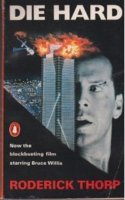 Joe, alone, against
terrorists on Christmas Day.
Pages of darkness.
Like a lot of people, Die Hard is one of my favorite action films. Each entry in the franchise has gotten worse, but nothing can take away from the brilliance of the original. It’s been a while since I saw it, but I was curious to watch it again because I just finished the novel from which it is based.
I can’t recall how I was led to the novel, but I was intrigued when folks who have read it said it was both the same and different, in all the right ways. It’s a slim book, bare over 200 pages, easily readable in a single sitting. It took me about six sittings, but that’s because I’m just a slow reader.
If you are a fan of the movie, you will like a lot of what’s in this book (originally titled Nothing Lasts Forever, by Roderick Thorpe — what a cool name!). So much of what John McClane goes through (Joe Leland in the novel, and he’s much older here, I believe in his late fifties) — barefoot on the broken glass, C4 down the elevator shaft, pistol sneakily strapped to his back — are in the novel. And yet at the same time, so much of it is not there, and I don’t just mean plot mechanics or dropped scenes. The book is way darker, and because it is told in a limited third person from Joe’s point of view, we are left with a work that spends much of its time inside his head. So as action filled as this novel is, it’s also intensely introspective. There’s also a greater sense of moral ambiguity, as the purpose behind the skyscraper takeover is as black and white as it is in the movie.
Seeing Die Hard again after all these years (I can’t remember seeing the film in its entirety in at least ten years) was a study in nostalgia. Smoking inside the airport! Car phones! Cocaine! One aspect I noticed this time was the omnipresent soundtrack — it’s a bit too pervasive and felt dated. Was Alan Rickman supposed to be German or English? His accent was kind of all over the place. But these are niggling complaints. The movie holds up in every way — well, maybe except for the ending (do I need to do a spoiler alert here?), when Karl returns from the seeming dead with guns blazing. The novel handles this in a much more logical manner.
Presenting Peggy.
Roger and his winning votes.
Cooper’s song and dance.
Benson’s gift for Joan.
Burger Chef without the guilt.
Don and Peggy’s dance.
Smiling Uncle Don.
Ginsberg’s van Gogh-ish nipple.
Big Tobacco love?
Don on Peggy’s team.
Roger with hippies — and mud.
Tag writing, sober.