To quote another fine New Jersey artist — oh what a night! I live in the wonderful town of Washington in beautiful Warren County, and I can literally walk to the Warren County Community College. This was my second reading, and I read most of the first chapter to keep it around twenty minutes, but that’s not all — I got to share the stage with the students who won the 2009 Warren County High School Fiction and Poetry Contests. Plus we were also celebrating the release of Ars Poetica, the art/literary magazine of the college, so many of the authors who were published in the journal got up to read as well. Professor BJ Ward was the master of ceremonies, and he gave me an introduction that I didn’t deserve (which didn’t stop me from accepting it with great thanks). It was an evening of literary community in my very home town, and I couldn’t have been more proud.
Category Archives: Writers and Writing

Google Alert and Korean Interview
 In preparation for the avalanche of media coverage that will be exploding like a volcano (talk about mixing some bad metaphors), I have set up a Google Alert with my name, and lo and behold, I actually got a hit. The article is from my hometown newspaper, the Warren Reporter. It all looks good, except they said my novel came out last month. But hey, press is press, so I’m grateful.
 The other bit of news I found today was that an email interview I did a little while ago got in The Korea Daily. It’s been there for about two weeks, so if I hadn’t been so lazy setting up my Google Alert, maybe this would’ve been my first. In any case, for those who want to read the interview in English that I’d originally done with the reporter, check out the exchange below. The Korean version has been shifted around here and there, but it’s basically the same thing.
Advice from Glimmer Train
Just read two excellent pieces from Glimmer Train’s latest bulletin. One is by Jeremiah Chamberlin, about workshops, titled “Workshop Is Not for You”:
Whenever my students complain about workshop, their gripes invariably have to do with issues of reciprocity. Or, rather, the lack thereof—they have spent a great deal of time carefully reading and writing thoughtful comments on the work of their peers, only to receive the vaguest feedback in return.
I can certainly relate, having been through many workshops. It’s a nice, positive spin on a sore subject. Then there’s Aaron Gwyn’s piece, simply titled “Trouble”:
Trouble, trouble, trouble.
“In life, we want peace,” I tell them. We want love, and peace, and job security. In literature, not so much.
I’m printing this one out, because even though I know it, I so often forget it.
Salinger’s Nine Stories
 A book of stories that runs less than 200 pages shouldn’t take two months to read, but that’s what happened with J.D. Salinger’s Nine Stories. I wish I could lay blame on Salinger’s prose, and maybe I could — certainly the first page of “Pretty Mouth and Green My Eyes” qualifies as dense — but that argument wouldn’t stand a chance against “Uncle Wiggily in Connecticut,” which is like 80% dialogue. Actually, “Pretty Mouth,” outside of that first paragraph, is just as dialogue-driven as “Uncle Wiggily.”
I’d think it’s pretty much impossible to discuss Salinger without mentioning his talent for dialogue. Here’s just a tidbit from “Uncle Wiggily”:
“Oh, I’m dying to see her,” Mary Jane said. “Oh, God! Look what I did. I’m terribly sorry, El.”
“Leave it. Leave it,” said Eloise. “I hate this damn rug anyway. I’ll get you another.”
Salinger doesn’t mention the spill at all. He doesn’t have to. The use of italics, the repetition — there’s a hyperreality to the conversation that takes this story into a realm above and beyond fiction. It’s more like you’re eavesdropping into this story than reading it. It is very impressive — Richard Yates was also a fan of Salinger, and especially this story in particular, and now I can see why.
John Updike

W. Earl Snyder, courtesy of John Updike (circa 1960)
The New Yorker has been putting up reactions by various writers about Updike’s passing, and this one by George Saunders caught my eye:
Back in 1992, I had my first story accepted by The New Yorker. It was going to run in Tina Brown’s first issue. I soon learned that, in honor of the occasion, the magazine was going to run two short stories, and that the idea was to contrast the new (me) with the established.
I remember this very well, because I was a sophomore in college and was writing for the Cornell Daily Sun. In order to become a Sunnie, you had to go through what they called a “compet program,” meaning you had to write some news stories to get your feet wet. I had no intention of writing news stories, but you gotta do what you gotta do. So I wrote a couple of pieces, one of which involved attending a lecture about black holes. At the end of the interview, I walked up to the scientist to get some quotes, but I was thwarted when Carl Sagan threw a couple of sharp elbows into my ribs and pushed me out of the way.
But I’m losing my focus here. I’m not here to talk poorly of the dead (sorry, Carl), but rather about one of the first pieces I wrote for the Arts & Entertainment section of the Daily Sun. For that column, I reviewed this very first Tina Brown issue of The New Yorker, and I still vividly recall this story by Saunders because it was bona fide science fiction, and not only that, it had a killer ending.
As for the Updike story in the issue, I’m afraid I don’t remember it, which probably means it was as sparkling as all of his stuff has ever been. I do remember the very last short story he had in the magazine, “The Full Glass” quite clearly: like most of his stuff written in the later years, he displays a masterful retrospective voice. It didn’t occur to me for a second that this might be his final non-posthumous (humous?) work in The New Yorker, but that’s the way it goes, isn’t it? Here today, gone tomorrow.
The Best of Everything
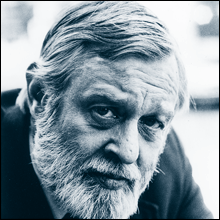 Listen to the great Richard Yates reading his short story, “The Best of Everything.” The quality is excellent.