First-World Problems, My Column in KoreAm Journal

I’m very proud to announce that I’ve been asked to be a columnist for KoreAm Journal, a magazine I’ve contributed to from time to time.  First-World Problems is what I’m calling it, and the inaugural column appears in this month’s issue.  It is available in print and online, so please check it out.

First-World Problems

Hi there. My name is Sung, and if you’ve been a longtime KoreAm reader, you may have read some of my essays in the magazine over the years. I’m a writer, which means I actually don’t do a lot of writing. Mostly I spend my time staring out a window with a blank look on my face, or Googling something integral to the subject at hand only to find myself an hour later reading about the life cycle of mollusks. (I wish I was joking, but alas.)

[more]

Haiku and Review: The Best Years of Our Lives, Laura, and Make Way for Tomorrow

Recently I had the idea to catch up with some old movies, so I looked up the AFI 100 list to see which films I haven’t seen.  Turns out there are plenty, so I picked one out, and it led to another, and then another, and I have a feeling I’ll be seeing more old movies in the future.  I feel foolish for once thinking that I wouldn’t relate to films made before 1950 (All About Eve and Sunset Blvd. seemed like a decent starting point).  How wrong I was!

bestyears

Three World War 2 vets
return home and try to find
family and love.

It’s almost three hours long and I wish I were ten times longer.  It’s not a complicated story, about three different generations of men who return from WWII.  One has emotional scars, what we’d now diagnose as PSTD; another has physical scars, the loss of both hands; and the last struggles to readjust to his family and his job.  When I first saw Harold Russell, who plays the man with hooks for hands, I marveled at his skills with his hooks (lighting a cigarette, opening doors, etc.), thinking he must’ve put a lot of hours to master them for his acting gig.  In reality, he did lose his hands in the war and he wasn’t even a professional actor!  Here’s a bit of trivia that might come in handy one day: Russell is the only actor to have won two Oscars for the same role.  When the awards were given that year, the Academy wanted to honor him and the vets, so they created a special award for him, thinking he had no chance of winning Best Supporting.  He won them both.

There are two highlights in this movie: the scene between Frederic March and Myrna Loy, who play the parents to Theresa Wright.  In their bedroom, the three of them have a conversation about love that just may knock your socks off.  My socks are still knocked out cold.  The other highlight is purely visual, of Dana Andrews walking along the decommissioned airplanes.  I suppose nowadays they’d just CGI it, but here, it’s real, and that makes it even more powerful.

laura

Laura (1944)
Who killed Laura Hunt?
Her fiancé? Her dandy?
Ask her, detective.

I wanted to see more of Dana Andrews, so Laura was the next film.  Two years older than The Best Years of Our Lives, it is known as one of the best noirs of its time, and the film lives up to that expectation and then some.  Though Andrews plays the hard-boiled detective, the reason to see this movie is for Clifton Webb, who plays a writer and a…I’m having a hard time coming up with an apt description for his relationship with Laura, because it’s just sort of weird.  He’s definitely in love with her, but it never feels like a straight-up man-loves-woman kind of thing.  Not exactly mentor and mentee, either.  You should just see the movie to find out for yourself.

Vincent Price plays Laura’s fiancé, and I never knew what a handsome, strapping lad he was in his youth.  Before Laura, the only Price I knew was the laugher in Michael Jackson’s Thriller and the inventor in Edward Scissorhands.

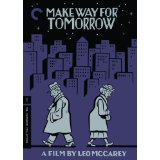
makeway
Ma and Pa Cooper
must live without the other.
This heartbreak is pure.

This film is almost eighty years old, and yet it is startling how much it applies to our current times.  The story, again, is deceptively simple.  Aged parents lose their house to the bank, but none of the five children want to take them both on, so Pa goes with one daughter while Ma goes with one son.  The actors are naturalistic in their performance with very little melodrama, which is amazing since this is 1937!  In a way, the last twenty-five minutes of this movie reminded me of Richard Linklater’s Sunrise series — two people walking and talking about their lives and viewpoints.  Even though the film is sad and grim, there are plenty of laughs, once again reinforcing my steadfast belief that humor is a vital ingredient of every movie in every genre.  The ending — oh, the ending.  The director, Leo McCarey, lost his job because he wouldn’t change it.  He took one for the team, and we are now forever blessed by his stubbornness.

Familiar, by J. Robert Lennon

It’s a little late for some spring cleaning, but that’s what I’m sort of doing right now.  This was a review of J. Robert Lennon’s Familiar that I wrote more than a year ago.  It was supposed to go somewhere else, but I blew the deadline and it didn’t make sense for them to post it, so it has basically languished on my hard drive for all this time.  Better late than never!

jpeg

Familiar, by J. Robert Lennon

Graywolf Press
205pp

I’m worried about Elisa Macalaster Brown, what she’s doing, where she is.  I’m worried because she’s not where she’s supposed to be, nor is she who she’s supposed to be.  How this happens is as quick and merciless as a car accident, and in a way, it sort of is one, because that’s where it occurs.  Elisa is driving east from Wisconsin, after visiting the gravesite of her dead teenage son.  Her Honda has a crack on its windshield that runs from the lower left hand corner to eye level – which, for reasons unknown, disappears.  Suddenly there’s mint gum in her mouth.  Elisa herself is slightly fatter, wearing stockings when she should be wearing cutoff jeans, and all I’ve described so far takes place in the first fourteen pages of this remarkably compressed, remarkably sad novel.

Part of what makes this speculative fiction work so well is Lennon’s use of the strong authorial voice.  The end of the first chapter ends with this sentence: “Everything’s going to change in a couple of minutes.”  That’s Lennon telling us how it’s going to be right from the beginning, that he is in complete control and everything that happens, no matter how improbable, will also be inevitable.  (Sherlock Holmes would be proud.)

Another narrative technique Lennon employs in service for the suspension of disbelief is the present tense.  I don’t know about you, but when I think of novels written in the present tense, John Updike’s Rabbit books come to mind.  Here’s what Updike had to say about it in an interview (http://www.achievement.org/autodoc/page/upd0int-5):

 I loved writing in the present tense. It has become a bit of a cliché now among younger writers, but at the time it was a bit of a novelty, and certainly a novelty to me. There’s kind of a level, a speed, you can get going without the past tense[.]

I haven’t written much in the present tense, but every time I do, it startles me to see how much more force there is in the writing.  The present is explosive and immediate, and since Familiar is a novel of discovery, not that different than, say, Jason Bourne’s story (a man waking up and not knowing who he is), the present tense is the right choice here.  Instead of suffering from amnesia, Elisa has “displace-sia,” of being in a world that is not exactly hers.  So as she moves through her not-quite-new life, we are discovering all that has changed with her, and because of the immediacy of the tense, we get very much more caught up in Elisa’s predicament.  Even though this novel is packed with Elisa’s internal thoughts and metaphysical ruminations of her situation, it just feels fast.

One of the highest compliment one writer can pay another is that he wishes he’d written the book he’s reading.  I absolutely felt that at times as I laughed and groaned my way through Familiar.  There’s just so much juicy stuff here in this alternate world of Elisa’s: her son is not dead, an acquaintance is now her best friend, the guy at the frame shop is no longer her illicit lover.  The scenes where Elisa returns to work, to fake her way to her office, pretending to know what she’s doing in her job – these are scenes any writer would love to write.  They are all so full of possibility and drama, the lifeblood of all great novels.

Beware, though – this is not a happy-go-lucky book.  Elisa doesn’t quite end up in Tony-Soprano-limbo-land territory, but there are no easy answers for anything or anyone in this novel, much like life.  For a book that deals in the fantastic, it is terrifyingly ground in reality.  Elisa’s eldest son may have never died in this alternate timeline, but that doesn’t mean her broken family is any less broken.

Lennon, who’s shown brilliance in both longer works (Mailman, an intense character study) and tiny stories (Pieces for the Left Hand, a collection of one hundred short-shorts that are gemlike in both form and content), has written a deeply unsettling book in Familiar.  As always, I can’t wait to see what he comes up with next.

For further reading:

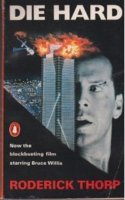
Haiku and Review: Nothing Lasts Forever, a.k.a., Die Hard

nothing lasts foreverJoe, alone, against
terrorists on Christmas Day.
Pages of darkness.

Like a lot of people, Die Hard is one of my favorite action films.  Each entry in the franchise has gotten worse, but nothing can take away from the brilliance of the original.  It’s been a while since I saw it, but I was curious to watch it again because I just finished the novel from which it is based.

I can’t recall how I was led to the novel, but I was intrigued when folks who have read it said it was both the same and different, in all the right ways.  It’s a slim book, bare over 200 pages, easily readable in a single sitting.  It took me about six sittings, but that’s because I’m just a slow reader.

If you are a fan of the movie, you will like a lot of what’s in this book (originally titled Nothing Lasts Forever, by Roderick Thorpe — what a cool name!).  So much of what John McClane goes through (Joe Leland in the novel, and he’s much older here, I believe in his late fifties) — barefoot on the broken glass, C4 down the elevator shaft, pistol sneakily strapped to his back — are in the novel.  And yet at the same time, so much of it is not there, and I don’t just mean plot mechanics or dropped scenes.   The book is way darker, and because it is told in a limited third person from Joe’s point of view, we are left with a work that spends much of its time inside his head.  So as action filled as this novel is, it’s also intensely introspective.  There’s also a greater sense of moral ambiguity, as the purpose behind the skyscraper takeover is as black and white as it is in the movie.

Seeing Die Hard again after all these years (I can’t remember seeing the film in its entirety in at least ten years) was a study in nostalgia.  Smoking inside the airport!  Car phones!  Cocaine!  One aspect I noticed this time was the omnipresent soundtrack — it’s a bit too pervasive and felt dated.  Was Alan Rickman supposed to be German or English?  His accent was kind of all over the place.  But these are niggling complaints.  The movie holds up in every way — well, maybe except for the ending (do I need to do a spoiler alert here?), when Karl returns from the seeming dead with guns blazing.  The novel handles this in a much more logical manner.

5/17/14, 6:15pm: Lit Crawl Brooklyn @ BookCourt

brooklynbanner

I’ll be reading my flash piece for PEN/Guernica on May 17, Saturday, at BookCourt.  The event is part of Lit Crawl Brooklyn, and it’ll run from 6:15pm until 7pm.  Here’s the 411:

An Evening with Guernica & PEN America
BookCourt (All Ages)
163 Court Street
In celebration of the PEN/Guernica Flash Fiction Series, an evening of literary debauchery. Featuring flash fiction readings by Mira Jacob, Kaitlyn Greenidge, Sung Woo, and special surprise guests.

Lit Crawl is a fantastic event, so please come on by.